"I want to marry my Filipino partner, but I haven't been able to confirm that they are truly single."
"I've heard about their job and their family. But as talk of marriage has progressed, I've started to notice parts of their story that don't quite match."
International marriage involves more than language and distance. Differences in marriage systems, family relationships, work and attitudes toward money all come into play. Precisely because you love your partner, you may feel hesitant to ask questions that sound like doubt. However, confirming important information before marriage is not a sign of distrust; it is also a way of preparing to protect your future together.
At TSK INTERNATIONAL, we accept consultations on identity and background checks before international marriage, with a focus on the Philippines. In this article, we outline the PSA documents used to check marriage history, the person's background and family relationships, remittance practices, and the limits of local investigations, and explain practical points worth knowing before you request an investigation from Japan.
Why Consider a Background Check Before an International Marriage in the Philippines
In an international marriage, even after a long relationship you may not know how your partner lives day to day. If you have met by traveling between Japan and the Philippines, or have mainly kept in touch through social media and video calls, you have limited opportunities to directly verify what your partner tells you.
Items you may want to confirm include your partner's name, marriage history, current job, whether they have children, where you will live after marriage, and financial support for relatives. All of these bear on married life, but there is no need to investigate every corner of another person's past. It is important first to talk frankly with each other, and then to prioritize the important questions that remain unresolved.
The starting point is not "investigating because the person is Filipino," but "confirming explanations that bear on the decision to marry." Nationality or financial circumstances alone should not be treated as grounds for suspicion. Focusing on specific inconsistencies helps prevent investigations that go too far.
How Much Can the Philippine CENOMAR Tell You About Marriage History?
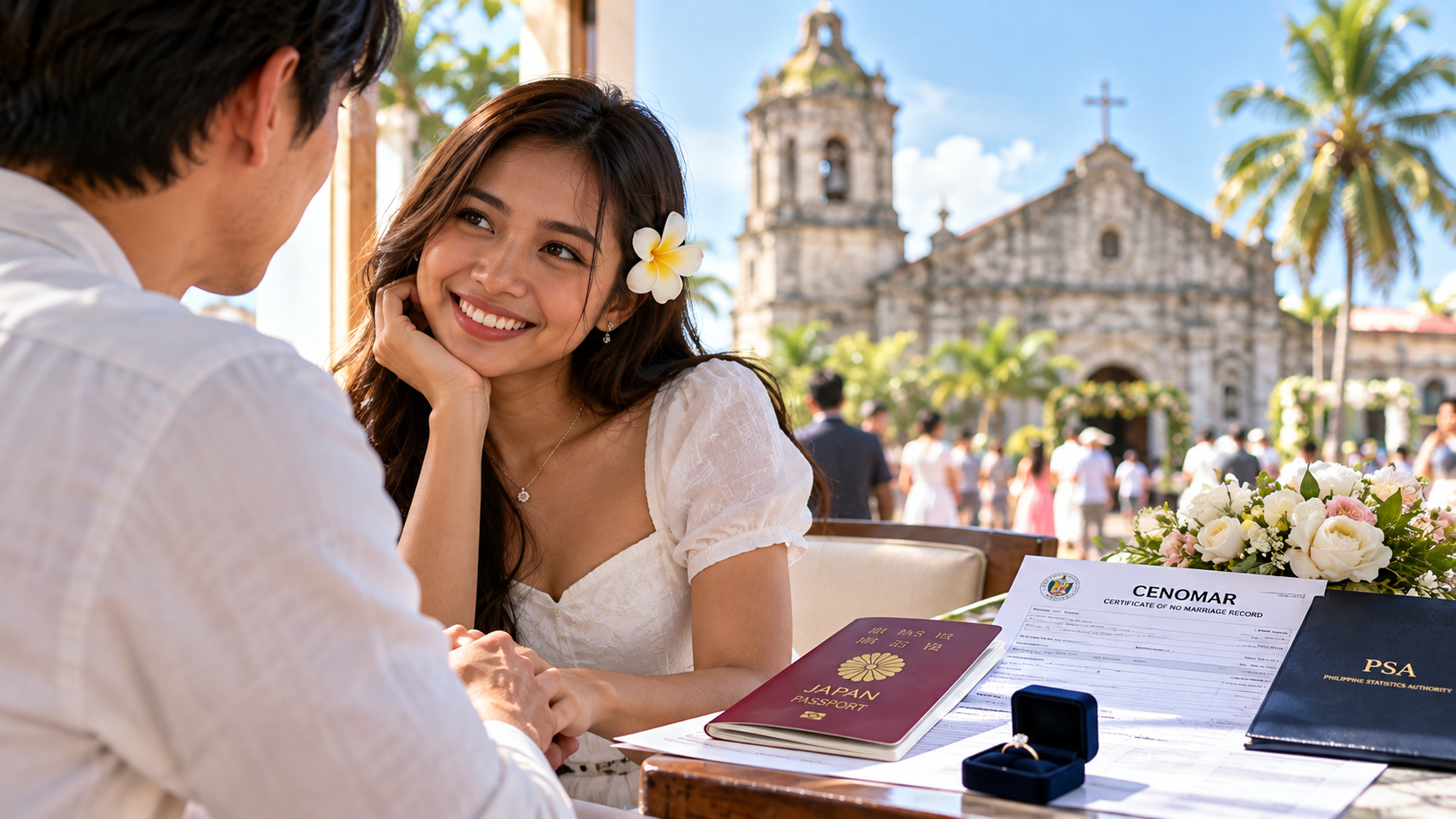
One of the key documents before marrying a Filipino citizen is the CENOMAR (Certificate of No Marriage Record) issued by the PSA (Philippine Statistics Authority). It certifies that no record matching the search criteria exists in the marriage records managed by the PSA. Its purpose differs from that of a Marriage Certificate.
However, being shown a CENOMAR does not unconditionally guarantee that the person has never been married anywhere in the world. Depending on individual circumstances, further checks may be needed regarding the state of registration, matching details such as name and date of birth, marriages abroad, and past legal proceedings. For people with a marriage history, other materials such as an Advisory on Marriages may also be relevant.
In 2026, the PSA announced electronic certificate services for the CENOMAR, marriage certificates and other documents. Electronic versions include a mechanism for verifying authenticity, but it is important not to make a snap judgment based only on an image of a document received from the person. For eligibility to obtain the documents, their purposes and how to verify authenticity, please check the official PSA guidance.
Watch for Remarriage, Separation and Past Marriages in the Philippines
"I've been separated from my ex-husband for years." "I was married before, but that relationship is over." Even with such explanations, whether the marriage has been legally dissolved is a separate matter. Applying Japan's divorce system as is may lead to a wrong judgment.
In the Philippines, legal confirmation based on individual circumstances becomes an issue, such as the annulment or declaration of nullity of a marriage, or the recognition of a divorce obtained abroad. It is not accurate to assume that someone cannot remarry simply because of a past marriage, nor to assume that someone is single simply because they are separated.
Calmly check whether the marriage history the person describes matches the contents of the documents presented. If you will marry in Japan, check the latest guidance from your Japanese municipal office and the Philippine Embassy or other relevant bodies; if you will marry in the Philippines, check the guidance of the competent local authorities. Legal eligibility requires the judgment of a professional.
Verifying a Filipino Fiancé(e)'s Name, Job and Background
Your fiancé(e)'s name differs from their display name on social media, their explanation of their workplace is vague, or their account of their education has changed from before. In such cases, do not immediately assume dishonesty; first check whether differences in spelling or timing explain it. In the Philippines, a person's formal name may differ from their nickname, and the use of surnames may change before and after marriage.
If you are told, "I work for a company in Manila," you may be able to confirm that the company exists in public corporate information or on its official website. However, the existence of a company is a separate matter from whether the person actually works there. Payslips, employment records and school records are not materials that third parties can freely obtain.
With the person's cooperation, ask them to present the necessary documents and check their explanations of items such as full name, date of birth and employment period one by one.Even if several points concern you, it is important not to mix verified facts withassumptions.
Understanding Family Structure, Children and Relatives in the Philippines
In the Philippines, it is common to see families who support one another daily, including parents, siblings and relatives. Staying closely connected to family after reaching adulthood, or frequently returning to a family home in the provinces, is not suspicious in itself. At the same time, how people relate to their relatives differs from family to family, so an individual should not be judged on cultural assumptions alone.
Before marriage, it is worth confirming whether your partner has children to support, what responsibilities they hold toward their family, and how far these will affect your life after marriage. Even if it feels awkward to ask whether there are children, it is an important matter that directly affects where you live and your household finances.
However, getting to know a partner's family is different from secretly gathering the identities of all their relatives. It is advisable to rely mainly on the person's own explanations and on documents obtained with their consent, and to confirm only the information needed for married life.
Remittance Culture in the Philippines and Money Issues After Marriage
"Even after we marry, I want to send money to my family every month." "I want to support my younger brother's school fees." In the Philippines, working family members often support their relatives. However, understanding this custom is a separate matter from the spouse on the Japanese side bearing unlimited costs.
Before marriage, discuss whether support for parents will continue, the monthly limit, how to handle sudden medical expenses, your savings goals as a couple, and how debt will be handled. When money is sent, it is important to clarify the purpose, amount and frequency, and to create rules that both of you accept.
Be cautious if you are pressured with statements such as "If you don't send it today, I won't marry you," if the reasons given for hospital bills or investment costs keep changing, or if you are intimidated when you ask for an explanation. If a relationship treats sending money as proof of love, take a step back and reconsider it.
Why Daily Life Differs Between Manila and the Provinces in the Philippines
The phrase "I live in Manila" can mean different things, depending on whether it refers to the City of Manila itself or to all of Metro Manila, including Makati, Quezon City and Taguig. Even if someone's workplace is in BGC, they may live in a neighboring province. Cebu also differs in travel conditions and living environments between the urban center, rural areas and the surrounding islands.
Addresses in the Philippines may include the province, city or municipality and barangay, as well as terms such as Subdivision, Sitio or Purok. Residents may also describe a location by a nickname or a nearby landmark, so it can be difficult to judge from Japan using a map alone.
If you have doubts about the residence or workplace your partner describes, first sort out what each place name or address actually refers to. An investigation carried out without understanding the local geography and living area may target the wrong location and increase costs.
Warning Signs of International Romance and Romance Scams in the Philippines
International relationships that begin on social media or dating apps have the advantage of allowing contact despite the distance. However, continuing video calls does not necessarily prove a person's real name, marital status, occupation or actual place of residence. Moreover, self-reported claims alone cannot tell you whether someone who says they live in the Philippines is really there.
- Pushing you toward marriage or large money transfers before meeting in person
- Repeatedly asking for money for hospital bills, travel costs, investment proposals and the like
- Continuing to avoid questions about their name or marital status
- Changing the name on the receiving account while pressing you to send money quickly
- Becoming angry when questioned, or hinting at a breakup or disadvantage to you
If several of these behaviors occur together, do not rush into marriage or additional payments, and consult a third party. If you suspect fraud and have already sent money, contact your financial institution and the police as a priority. Honesty or danger cannot be judged by nationality alone.
What a Background Check in the Philippines Can and Cannot Confirm
A pre-marriage background check is not unlimited surveillance of another person's life. Depending on the purpose and the conditions for obtaining it, there is information that can be considered for verification, such as the contents of marriage-related documents the person has presented, publicly available company information, and the existence of an address or business premises.
On the other hand, information such as bank balances, non-public medical records, school records, internal workplace information and private messages cannot be freely obtained. An investigation does not always establish whether a person's background is true, and failing to find a record does not immediately prove that something is false.
At TSK INTERNATIONAL, we place importance onorganizing findings by distinguishing verified facts, unverified matters and assumptions. An investigation cannot guarantee happiness after marriage, but it can be a way to reduce major unknowns needed for making a decision.
Identity Checks in the Philippines: Consent and Personal Data Protection
Under the Philippines' Data Privacy Act of 2012, information on marital status, health, education and similar matters requires particularly careful handling. Being a fiancé(e), or being a client who pays the fees, does not entitle anyone to obtain non-public personal information.
Obtaining PSA documents is subject to application requirements, and the person's consent or another lawful basis may be required. Avoid any request that presumes unauthorized login to private social media accounts, impersonation, or improper acquisition of information from banks, hospitals and the like.
It is important to check the laws and regulations that apply in both Japan and the Philippines, and to limit information gathering to the scope needed for your decision about marriage. An appropriate division of roles is to confirm the legal eligibility for marriage with public authorities or a lawyer, and to consult the investigation agency about the scope of fact-checking.
Requesting a Pre-Marriage Investigation in the Philippines from Japan: Process and Costs
From Japan, you can consult TSK INTERNATIONAL about identity and background checks before an international marriage. We begin by organizing the information you have been given by the person and the facts you wish to confirm. After assessing what we can handle, we will guide you through the investigation details, timeframe and an outlook on costs.
STEP 1|Free Consultation and Organizing Materials
Tell us about your relationship, your marriage plans, and points of concern such as marital history or workplace. You can consult us even if you do not yet know what to check first.
STEP 2|Feasibility and Estimate
We consider the person's consent, the availability of public records, and the scope of what can be confirmed locally. Costs vary depending on conditions such as region, number of items, translation and travel.
STEP 3|Contract, Verification and Results Report
We will enter into a formal contract only after confirming any additional fees, the investigation period, and the deliverables. Results are explained with confirmed facts clearly separated from unconfirmed matters.Fees and Processfor more information as well.
Rather than adding items from the start, narrowing the investigation to what is truly needed for your marriage decision is the key to reducing wasted cost and time.
Organize Your Philippines International Marriage Investigation Through a Free Consultation
Before an international marriage, what you want to know is probably not everything about the other person's past, but the facts essential to choosing your future with peace of mind. Is confirming marital history the priority? Are there inconsistencies in what you have been told about family or work? Do financial promises need to be clarified? The appropriate approach depends on your situation.
At TSK INTERNATIONAL, we handle international marriage and background check inquiries from Japan, with a particular focus on the Philippines. For details, please seeInternational Marriage and Foreign Fiancé(e) Background Checks.
TSK INTERNATIONAL / FREE CONSULTATION
Before you decide to marry, start with a free consultation to organize what needs to be confirmed
"Is he or she really single?" "Are the explanations about family and work accurate?" "I don't know whether an investigation is necessary." Any stage is fine. Organizing your concerns and confirming whether we can assist are free of charge. You can also use the AI Consultant on your screen.
Investigations in the Philippines require information and experience grounded in an understanding of local geography, administrative systems, language, and daily customs.Let us begin by identifying what truly needs to be confirmed, and which investigations you do not need to request.
Go to Free Consultation / Contact FormBefore commissioning any paid investigation from a detective agency, we recommend that you consult with us at least once.