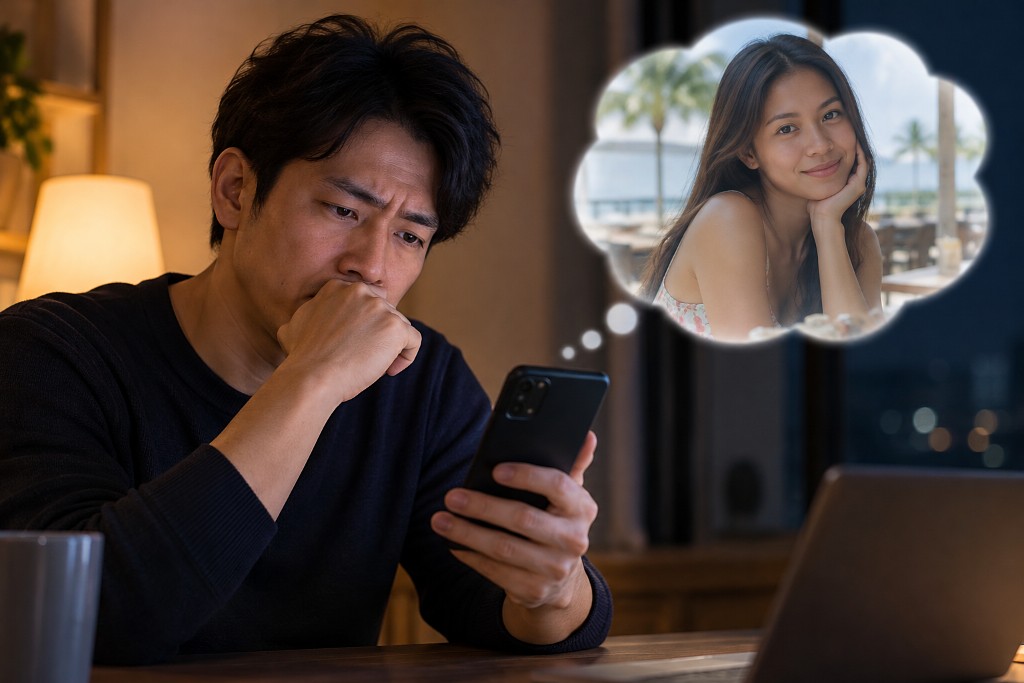
"I want to find someone I met in the Philippines in the past. But all I have left are an old photo and a name."
"I've lost contact with a family member who returned to Manila. Is it possible to check how they are doing now while I'm in Japan?"
Finding a person overseas is difficult in ways that simply searching for an address cannot solve. In the Philippines in particular, several factors differ from Japan: the sheer size of Metro Manila, regional differences from island to island, the way addresses are written, and the custom of calling one another by nicknames. The less information you can obtain from Japan, the more a misreading of the first lead can lead to a long detour.
At TSK INTERNATIONAL, we accept consultations on overseas person searches and whereabouts checks, with a particular focus on the Philippines. Drawing on local conditions, this article explains in concrete termshow to organize information, how to approach searching for an acquaintance from decades ago, and the costs and limits of an investigation. Before deciding whether a paid investigation is necessary, start by clarifying what you actually want to confirm.
Common Consultations and Purposes for Finding People in the Philippines
The purpose of a search varies depending on your relationship with the person you are looking for. You may wish to meet an acquaintance you have not been in touch with for many years, you may be worried about whether a relative who returned to the Philippines is safe, or you may want to tell someone who helped you in the past how you are doing now. The wish to find the person is the same in each case, but the verification methods required differ.
Methods differ between whereabouts checks, passing on messages and welfare checks. For matters involving property or legal procedures, a lawyer or similar professional may be more appropriate. Consideration must also be given to the possibility that the person does not wish to be contacted.
Finding someone and disclosing their address against their wishes are two different things. Clarifying your purpose at the outset helps you avoid an unnecessarily broad investigation and choose the right place to consult.
The Search Area in Manila, Philippines Is Wider Than You Might Expect
The information "that person must have lived in Manila" covers a much wider range than you might think. The City of Manila, the capital of the Philippines, and the metropolitan area known as Metro Manila (the National Capital Region, or NCR) are not the same area. According to the Philippine Statistics Authority, the NCR consists of 16 cities and 1 municipality, with 1,715 barangays, and had a population of approximately 14 million in 2024.
Makati, Quezon City, Pasay, Taguig, Pasig and other areas each have a different character. In addition, a person who worked in an office in Manila may have commuted from a neighboring province such as Bulacan, Cavite, Laguna or Rizal. If you confuse "worked in Manila" with "lived in Manila," the area you need to search can shift considerably.
The starting point of a search is not to take the word "Manila" at face value, but to break it down intoworkplace, residence, hometown and the place you last met. Even the same place name can mean different things depending on when the information dates from.
How Do Philippine Addresses and Barangays Differ from Japan's?
Philippine addresses are expressed in units such as province, city or municipality, and barangay. In residential areas, Subdivision, Block and Lot may be used, and in rural areas, fine-grained local names such as Sitio or Purok can serve as leads.
On the other hand, in some places road and house numbering is not standardized. Descriptions such as "behind the market," "near the church" or "the house with the blue gate" make sense to local people but cannot be used to pinpoint a location on a map. Buildings may have been demolished, or the appearance of a street may have changed.
A sign or shop name in a photo alone cannot prove where a person lives. It must be combined with the surrounding geography, administrative divisions and the age of the material. If you have an old address, it is important to keep the original text and compare it against candidates for the current notation.
Filipino Names, Nicknames and Languages Make Searching Difficult
In the Philippines, a person's formal name and the name they are called day to day may differ. Nicknames such as "Jun," "Boy" and "May" are used among family and friends, and some people choose a different spelling on social media. Depending on how surnames are used before and after marriage, or the presence of multiple given names, old records may not match a person's current name.
In addition, the name a Japanese person remembered in katakana may differ from the alphabet spelling used locally. Besides Tagalog, languages such as Cebuano and Ilocano vary by region, so even hearing and transcribing place names and personal names is not uniform.
Even if you search a common name and find someone with the same name, you should not conclude immediately that it is the person you are looking for. To avoid misidentification, you need to check against other leads that the person has appropriately shared, such as date of birth or region of origin.
7 Leads You Can Use to Find a Person in the Philippines
Even if you do not know an address, that does not mean you have none of the information needed for a consultation. What matters is to organize the fragments you have in a way that shows where each piece of information came from and when it was confirmed.
- Name: Legal name, former surname, nickname, and spellings in katakana or the Latin alphabet
- Photos: Facial photos received from the person, and buildings or scenery from that time
- Area: Island, province, city or municipality, barangay, and any familiar place names
- School: School names the person mentioned and the years they attended
- Work: Past employers, industry, and places where they worked
- Public social media: Profiles and past posts the person made public
- Last contact: The year and month, method, and circumstances of the last contact
For example, if the story is that the person "attended a school in Cebu around 2008 and later found a job in Manila," you can at least consider separately the period and the region that each piece of information points to. However, the fact that a school or company exists does not prove that the person was enrolled or employed there. Methods of obtaining non-public school or employment records without authorization should also be avoided.
Searching for an Acquaintance from Several Decades Ago in the Philippines
Searching for someone you met 20 or 30 years ago presents challenges that differ from a present-day person search. Phone numbers and addresses change, and neighborhoods are altered by redevelopment. Old place names may not match current administrative divisions, and surnames may have changed upon marriage.
In such cases, old letters, New Year's cards, notes written on the back of photos, school names, and past workplaces become important. Adding a timeline of "when, on which island, and in which area the person lived" can sometimes reveal the meaning of fragmentary place names.
If you wish to trace wartime records or the footsteps of those who died in the war, the work differs from locating a person who is alive today and involves cross-checking historical materials and old maps. Depending on your purpose, consulting specialized materials at archives and similar institutions may also be an option. Whether an old acquaintance is still alive, and whether they wish to be reunited, must be treated carefully as separate matters.
What Philippine Social Media and Public Information Alone Cannot Tell You
Facebook and Messenger are widely used to keep in touch with acquaintances in the Philippines. Public profiles may show a hometown or school name, which can serve as a lead.
However, even if a profile says "Manila," that is not necessarily where the person lives now. It may indicate a place they lived previously, their hometown, or the location of their workplace. The date a photo was posted may differ from the date it was taken, and family relationships cannot be determined from social media connections.
There is also a risk of confusing impersonation accounts or different people with the same name. We do not engage in unauthorized access using passwords or contact through fake accounts; verification is limited to public information and materials the person has legitimately shared.
5 Steps for Consulting from Japan About a Person Search in the Philippines
STEP 1 | Tell us why you want to search and what you hope for
Clarify your purpose, such as reunion, confirming the person's well-being, or relaying a message. Knowing your relationship with the person and when you last had contact gives us a starting point for the consultation.
STEP 2 | Sort the information you have
Gather names, old addresses, photos, public social media, and contact history, and separate reliable information from memories and guesses. There is no need to send large amounts of sensitive personal information at the outset.
STEP 3 | Consider lawful verification methods and whether we can handle the case
Taking local circumstances and laws into account, we judge whether checking public information is sufficient or whether specialized on-site verification should be considered. There are cases we cannot accept.
STEP 4 | Confirm the estimate and contract terms
Confirm the scope of the investigation, the duration, the basic fee, actual expenses such as transportation and translation, additional charges, and cancellation conditions. Make a request only if you are satisfied with the terms.
STEP 5 | Receive the verified facts in an organized report
Results are evaluated by separating what was confirmed, what could not be confirmed, and what is conjecture. Even if a person's whereabouts are found, we cannot necessarily disclose their address or contact details without their consent.
Urgent Welfare Checks in the Philippines and Public Authorities
If a crime, accident, disaster, disappearance of a minor, or danger to life or health is suspected, you should not wait for a private investigation estimate. Please consult the local police or the relevant public authorities promptly. When the safety of a Japanese national is at stake, consulting the Embassy of Japan in the Philippines or similar offices may also be appropriate.
In addition, the Ministry of Foreign Affairs of Japan has a "whereabouts investigation" system for Japanese nationals whose whereabouts have been unknown overseas for a long period, which in principle accepts requests from a spouse or a relative within the third degree of kinship. Because there are eligibility conditions and limits on information provided due to the person's own wishes, please check the official guidance.
Reference: Ministry of Foreign Affairs of Japan, "Whereabouts Investigation (Requests from Relatives Within the Third Degree of Kinship)". This administrative system differs in scope and role from private person-search consultations, which include foreign nationals.
Person Searches in the Philippines, Personal Information, and the Person's Wishes
Even when the purpose of a search is well-intentioned, the privacy of the person being sought cannot be ignored. The Philippines has the Data Privacy Act of 2012, which requires a lawful purpose and appropriate handling for the use of personal information. Government agencies, hospitals, schools, and similar bodies cannot freely hand over a person's address or records to third parties.
If the person does not wish to be contacted, direct contact or detailed disclosure of information may not be appropriate even if their location is found. If the purpose of a request could lead to harassment or unjustified tracking, the investigation should not proceed.
At TSK INTERNATIONAL, we do not regard locating a person as the sole measure of success. We place importance on verification that respects the law and the individual's rights. We do not promise that a person will always be found or that an address will always be provided.
Costs of Person Searches in the Philippines and Points to Note About Estimates
There is no uniform public fee standard for person searches in the Philippines. The time and expenses required differ greatly between verification within Metro Manila and cases that involve travel to Cebu or to provincial islands. If the information is old, work may first be needed to cross-check the leads.
When reviewing an estimate, confirm not only what will be investigated but also the number of investigation days, local travel costs, translation and document verification fees, and the conditions for additional investigation. It is also important to confirm, before signing a contract, how cases without results and mid-term cancellations are handled.
In some cases, your questions may be resolved before you commission an investigation, or a public consultation service may be more appropriate. Narrowing down the investigation you actually need before requesting a quote also makes the costs easier to accept. For details, please see Overseas Investigation Fees and How to Request.
Start Your Philippines Person Search with a Free Consultation
When searching for someone in the Philippines, having only a few names or photos can be a source of real anxiety. However, organizing the information you currently have by time, place, and source can make it easier to decide what to verify first. There is no need to commission an expensive investigation right away.
TSK INTERNATIONAL accepts consultations from Japan on person searches and whereabouts checks, with the Philippines as a key focus region. We confirm the target area, the purpose of the investigation, and the leads you currently have, then outline the methods that can be carried out and an estimate of the costs. You can also find more details about our services on the Overseas Person Search & Whereabouts Check page.
TSK INTERNATIONAL / FREE CONSULTATION
For a person search in the Philippines, please start with a free consultation to organize your situation
"I only have a name and an old photo." "I heard they were in Manila, but I don't know the exact address." "I'm worried about the safety of a family member far away." You are welcome to contact us even at this stage. Organizing your inquiry and confirming whether we can assist are free of charge. You can also use the AI Consultant on this screen.
Investigations in the Philippines require the information, experience, and knowledge of people who know the country well.It is important to consider what can be verified, taking into account the local geography, administrative divisions, daily customs, and languages.
Go to the Free Consultation / Contact FormBefore commissioning a paid investigation from any detective agency, we recommend that you consult with us at least once.